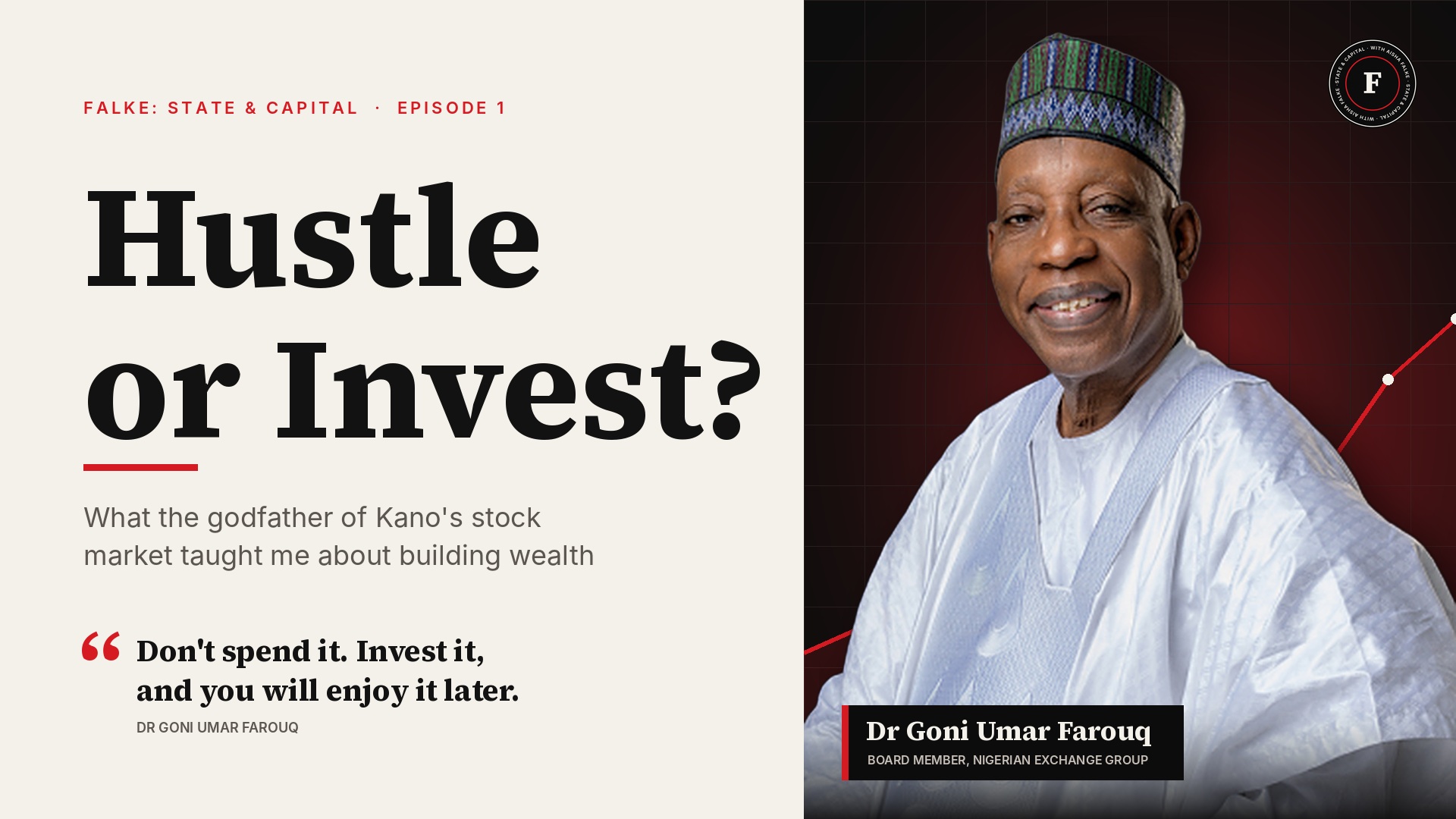
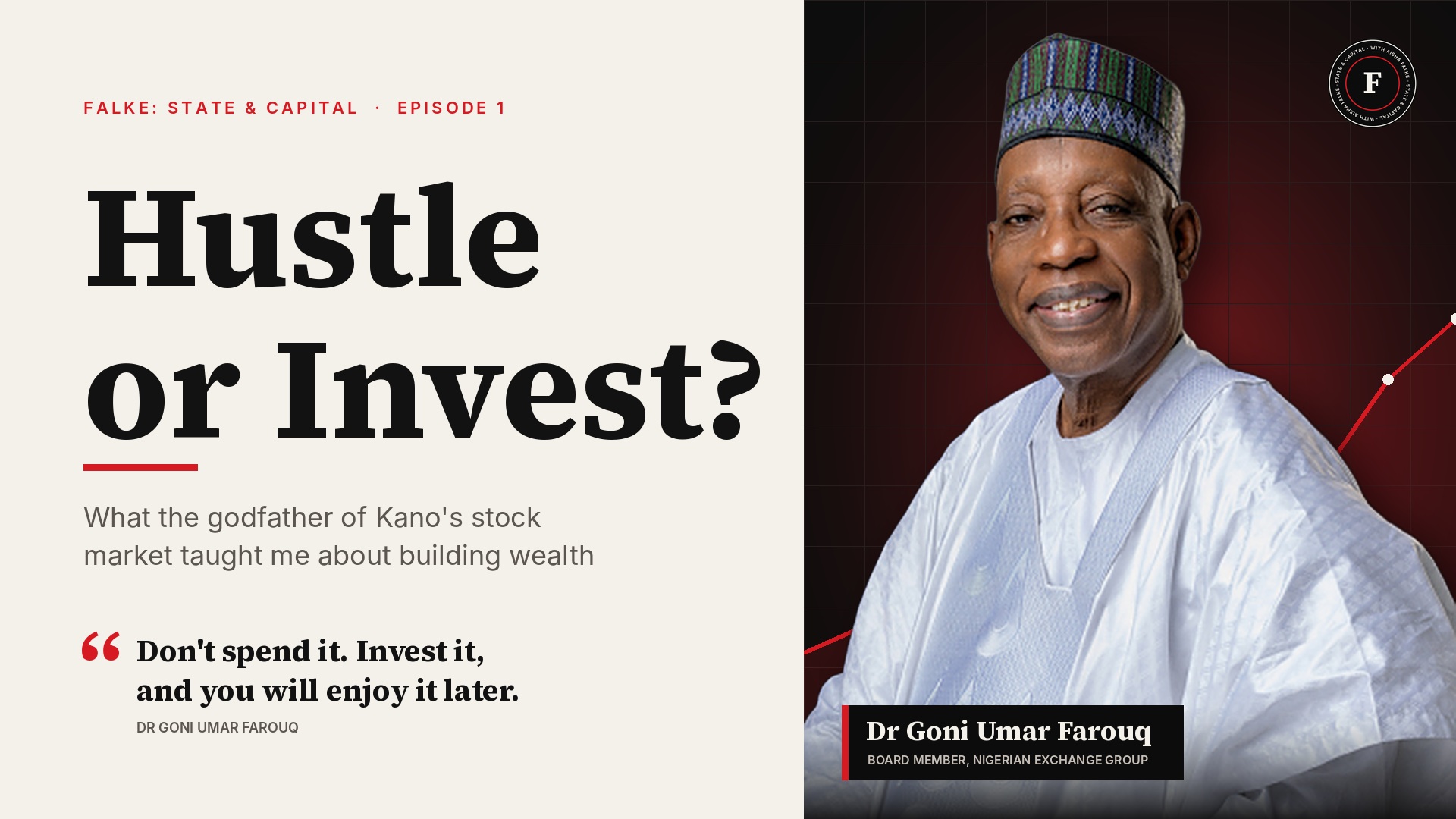
In the first episode of Falke: State & Capital, Aisha Falke sits one on one with Dr Goni Umar Farouq, the man both Aliko Dangote and the Emir of Kano acknowledged at the Dangote IPO homecoming in Kano, to answer the question many Nigerians are asking: keep hustling, or invest?
By Aisha Falke
At the Dangote IPO homecoming in Kano, one name kept coming up from the podium. Alhaji Aliko Dangote acknowledged him, and so did the Emir of Kano. In a room full of powerful people, Dr Goni Umar Farouq was being singled out by two of the most respected men in the North, and I knew I had to sit down with him one on one.
The timing could not have been better. Across Nigeria, people are asking the same question the IPO has brought to the surface. Should we keep hustling, trading and turning our money over every week, or should we put some of it into big, solid companies and let them pay us dividends year after year?
It’s not an abstract question. Here, wealth has long meant land, livestock, shops in the market and goods that move. The stock market has always felt like something that happens in Lagos, for people who speak a language of tickers and portfolios we were never taught. Yet the companies listed on the Nigerian Exchange are the same companies whose cement builds our homes, whose planes land at our airports and whose products fill our shops. Someone owns them, and every year someone collects the dividends.
So I sat with the man many people call the godfather of the capital market in Northern Nigeria.
From the classroom to the boardroom
Dr Goni Umar Farouq’s story does not begin on a trading floor. He started as a lecturer at the School of Preliminary Studies in Kano in 1977, after earning his first degree in education at Bayero University Kano. He went on to a master’s at Ahmadu Bello University, Zaria, and later a PhD in Educational Psychology from the University of Wisconsin in the United States.
He served the Kano State Government as Permanent Secretary, Special Duties, and in 1993 he was MKO Abiola’s campaign coordinator in Kano, a role that placed him at the centre of one of the most important political moments in Nigeria’s history.
Over the decades that followed, he moved steadily into the boardrooms of some of the country’s biggest listed companies, including Ashaka Cement, Cement Company of Northern Nigeria, NAHCO and Union Homes Savings and Loans. He has sat on the audit committees of Seplat and Nascon, and today serves as an Independent Non-Executive Director of the Nigerian Exchange Group. He has also served on the committees that reviewed the Investment and Securities Act and the Companies and Allied Matters Act, the laws that govern how our capital market works.
He is a billionaire, and much of that wealth was built the patient way, by owning shares. Today, the stock market is all he does.
Never stop learning
What stayed with me most was not the money. It was how often he came back to learning.
A man with a doctorate, decades of board experience and a fortune to show for it has gone back to Harvard eight times. In his view, you never stop going back to seek knowledge. Before you can make money work for you, you have to understand how it works, and that understanding needs constant updating as markets, laws and companies change.
For a region where many of us were raised to see education and business as separate paths, his life suggests otherwise. The classroom was where his wealth began, not a detour from it.
Don’t spend it, invest it
When I asked what he would tell young people, his answer was simple: don’t spend it, invest it, and you will enjoy it later.
It sounds easy, but it cuts against almost everything around us. Social pressure tells us to spend, to show, to celebrate every win in public. Hustle culture tells us to keep money moving, chasing the next quick turnover. His advice asks for something harder: setting money aside in companies you believe in, and then waiting.
He made the case that ownership builds a different kind of wealth from trading. Trading pays you only while you are working. Owning shares in strong companies pays you while you sleep, in dividends and in the growth of the business itself, and that wealth can be passed on.
So, hustle or invest?
I left our conversation with a clearer answer than I arrived with. It isn’t one or the other. The hustle is how most of us earn. But if every naira we earn goes back into the hustle or out on spending, we will always be working for money and never have money working for us.
The Dangote IPO has opened a door for ordinary Nigerians to own a piece of one of Africa’s largest companies. Whether or not you walk through that particular door, the lesson from Dr Goni is worth carrying: learn how the market works, start where you can, and give your money time.
If you are a trader, a civil servant, or someone with small savings wondering whether the stock market is for people like you, this conversation is for you.
About the guest
Dr Goni Umar Farouq is Chairman of the Arewa Consultative Forum, Kano Chapter, and an Independent Non-Executive Director of the Nigerian Exchange Group. He also sits on the boards of Greenwich Merchant Bank, Fortis Global Insurance, GTL Registrars and the Nigerian Capital Market Development Fund. He holds a B.Ed from Bayero University Kano, an M.Ed from Ahmadu Bello University and a PhD from the University of Wisconsin. He is a Fellow of the Institute of Directors, an INSEAD alumnus and a Harvard Business School certified corporate director. He holds the title “Goni”, given to him by the late Emir of Kano, Alhaji Ado Bayero, in recognition of his memorisation of the Holy Quran.
Watch the full conversation
Falke: State & Capital, Episode 1 with Dr Goni Umar Farouq, is available now on the Northern Hibiscus YouTube channel.
Falke: State & Capital is a Northern Hibiscus original. Where power meets enterprise.
This article is for education only and is not financial advice. Speak to a licensed stockbroker before investing.