






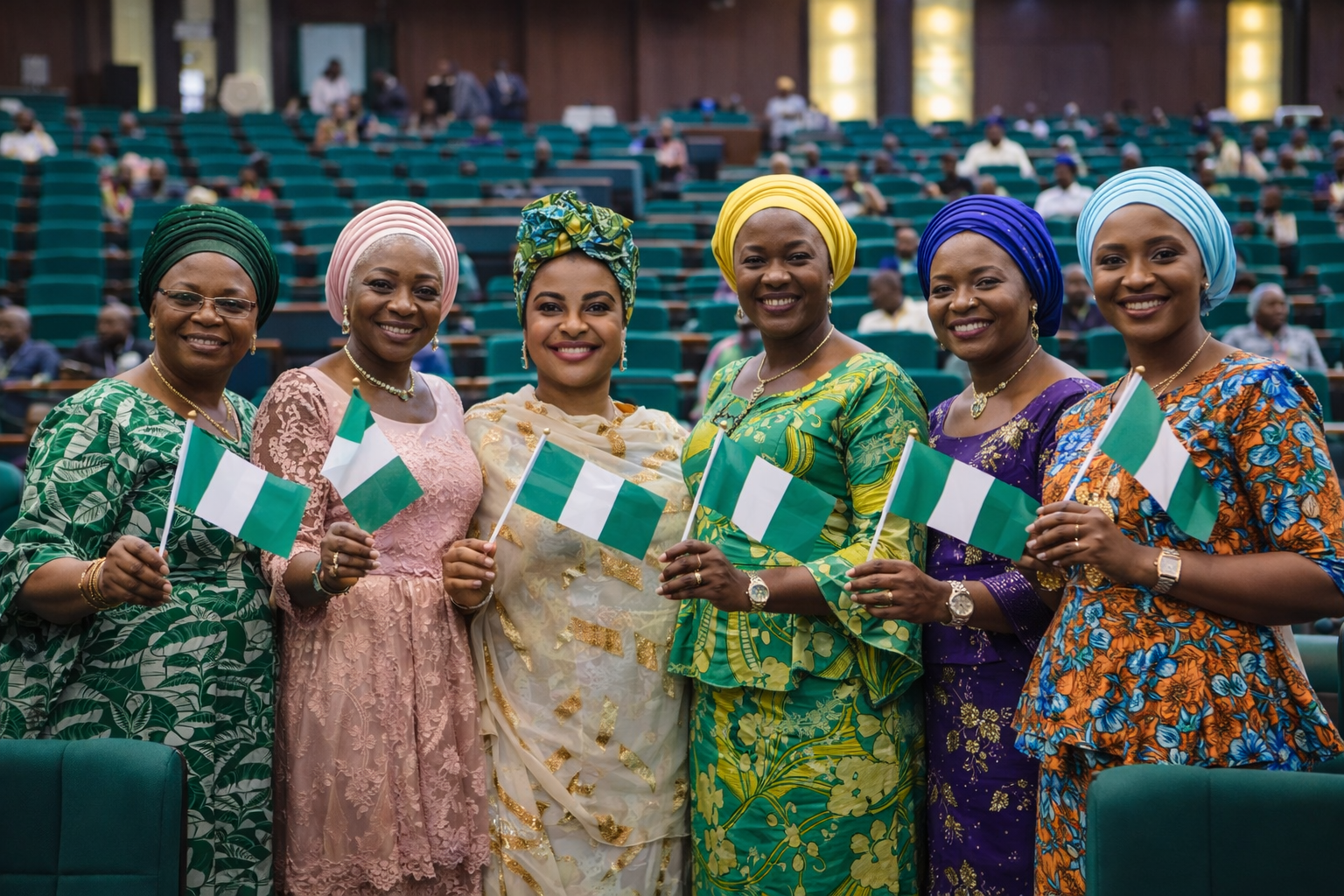
Efforts to increase women’s representation in Nigeria’s political institutions have taken on renewed urgency as the proposed Reserved Seats for Women Bill moves through the legislative process in the National Assembly.
Stakeholders, civil society groups and some lawmakers argue that the bill is a corrective response to decades of under-representation of women in elected office. Women currently hold only a small fraction of seats in Nigeria’s legislature, with fewer than one in 20 members of the National Assembly being female — a situation advocates describe as “persistent and structural.”
The bill, formally introduced as a constitutional alteration proposal, aims to create additional legislative seats to be contested exclusively by women in both federal and state assemblies. Under the main proposal, an extra Senate seat would be created for each of Nigeria’s 36 states and the Federal Capital Territory, and a corresponding additional seat in the House of Representatives would also be reserved for women. At the state level, the bill proposes three additional seats for women in each State House of Assembly, one for each senatorial district.
Proponents say the measure does not reallocate existing seats but adds new ones to the legislature that women can contest. This means the current legislative seats remain unchanged and open to all candidates, while the reserved seats provide a parallel mechanism for increasing women’s voice in law-making.
Support for the bill has come from a range of quarters. Activists and women’s organisations have described the proposal as a necessary corrective tool rather than a privilege. At a recent press event, representatives from the International Federation of Women Lawyers said the bill should be seen as part of a broader effort to advance women’s participation in politics and public life.
Governors and political leaders have also weighed in. Kaduna State governor Uba Sani publicly lamented that women’s participation in politics does not reflect their numerical strength in the country and backed the reserved seats initiative.
Advocates say the bill would address long-standing barriers to women’s political participation in Nigeria, where entrenched socio-cultural, economic and institutional challenges have historically limited women’s access to elected office. Observers point out that without deliberate measures, women’s representation is unlikely to improve meaningfully on its own.
Critics of the bill, while not opposed to increased female participation, have raised questions about the implications of expanding the legislature and the fairness of creating separate seats. Some have also questioned whether reserved seats would merely create parallel positions rather than promoting deeper structural change in party politics.
If passed, the bill would require a constitutional amendment, which means it must secure the requisite support in both chambers of the National Assembly and be approved by a sufficient number of state assemblies before it can be sent to the presidency for assent.
With the 2027 general elections approaching, backers of the bill are urging lawmakers to take decisive action so that any changes can be implemented in time for the next electoral cycle. They argue that improved gender representation would not only enhance democratic inclusiveness but also strengthen policy outcomes by bringing more diverse perspectives into decision-making.