
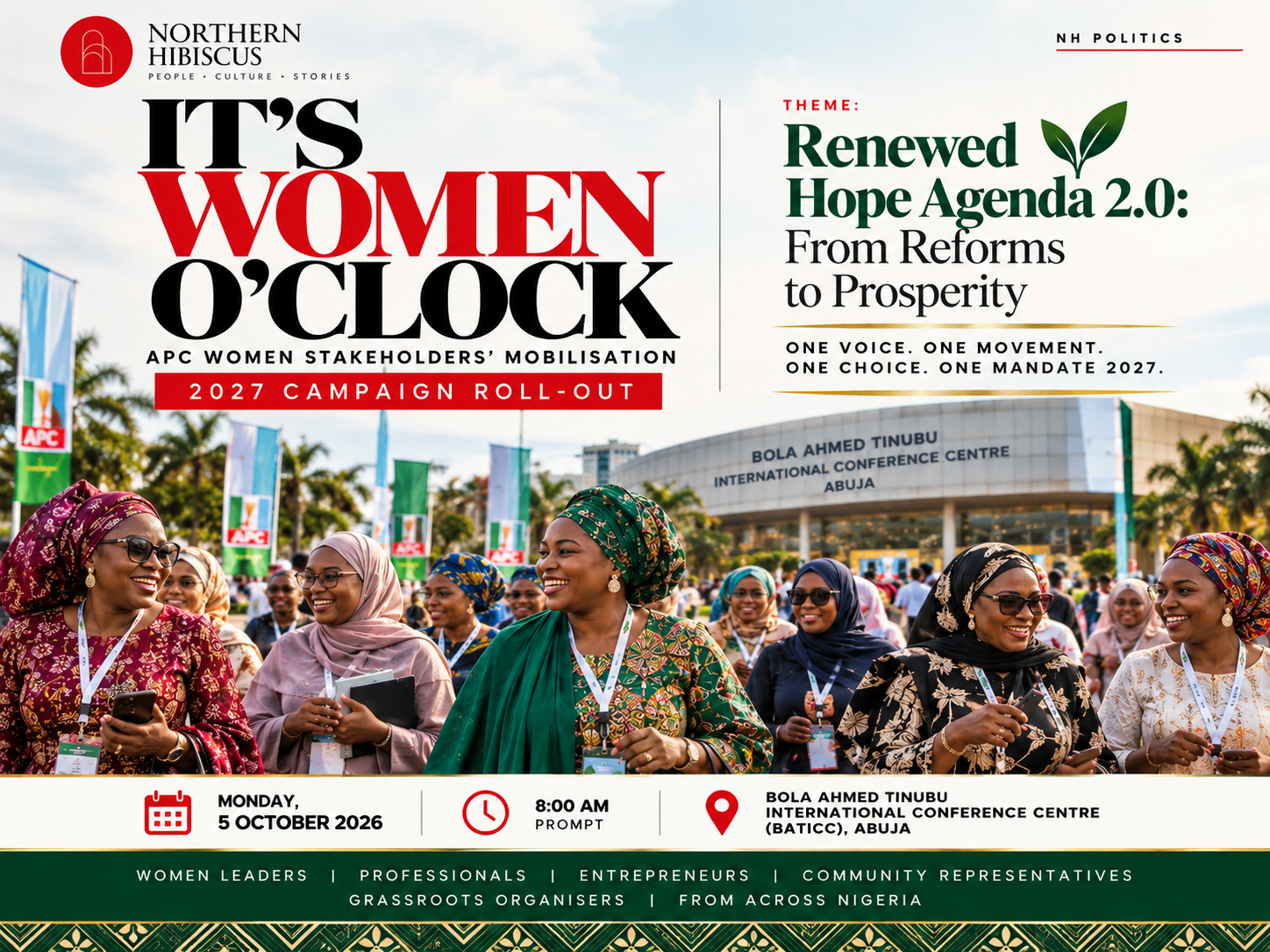
APC WOMEN GATHER IN ABUJA AS 2027 MOBILISATION BEGINS
Lokaci ne fa na mata
As the APC opens its 2027 campaign with a gathering of women in Abuja, the real audience for Renewed Hope is not in the hall. It is waiting at home, doing the sums.
Ba a cin zaɓe sai da mata. Every seasoned politician in the North knows the saying, even if few repeat it on a podium: no election is won without the women.
In Nigerian politics, you can tell an election is near not by the posters but by the phone calls. The meetings grow larger, the WhatsApp groups grow louder, and sooner or later someone in a party office says the sentence that has opened every serious campaign in this country’s history: we need the women.
On Monday morning in Abuja, the APC says it out loud.
Women stakeholders from across Nigeria, [confirm figure] by the organisers’ estimate, will gather at the Bola Ahmed Tinubu International Conference Centre for the Women Stakeholders’ Mobilisation and Empowerment Pre-Inaugural Campaign Rollout, organised by the Women Mobilisation Directorate of the 2027 APC Presidential Campaign Council and convened by the First Lady, Senator Oluremi Tinubu. The theme is “Renewed Hope Agenda 2.0: From Reforms to Prosperity,” and the rallying line beneath it is built to be chanted: “One Voice. One Movement. One Choice. One Mandate 2027.”
The speeches will be delivered in a conference hall. The verdict on them, as every woman in that room already knows, will be delivered somewhere else entirely.
Saboda magana daya ce. Rayuwa kuma wani abu ne. What is said is one thing; how we live is another.
The economist nobody interviews
There is a woman who never appears in a budget speech, yet understands the Nigerian economy better than most of the people who write them. She notices the price of tomatoes moving before the inflation figures do, she knows which supplier will still give her goods on credit, and she has quietly worked out how much is left in the house after school fees and transport. If she runs a business, she can tell you to the naira what the past three years have done to her margins.
For her, prosperity is not a forecast. It is cash flow, the difference between restocking her stall and selling off what remains, between hiring a girl from the neighbourhood and doing the work alone. When a politician comes asking for her vote, her question is short and entirely reasonable.
Me zan samu? What do I get from all this?
That question, more than any slogan, is what Monday’s gathering is really about.
From reform to prosperity
The government’s answer begins with the hardest decisions it made. When President Bola Ahmed Tinubu took office in 2023, his administration ended the petrol subsidy and overhauled the foreign-exchange system almost at once. The reforms were presented as overdue surgery on a sick economy, and households felt the cuts immediately, in transport fares, in food prices and in the steady shrinking of what a salary could buy.
Three years on, the language has changed. In his Independence Day address on 1 October, the President told Nigerians that the hardest phase was behind them. “Now begins the age of prosperity,” he said, while acknowledging that millions of families are still struggling with the cost of food, school fees, healthcare and transport. Monday is where the campaign begins turning that declaration into a door-to-door argument, and it has chosen women to carry it.
Where policy meets a woman’s life
The case the party will make rests on a long list of programmes, and what decides whether each one counts is whether it reaches an actual person.
Take education. The Nigerian Education Loan Fund offers interest-free loans to students in tertiary institutions, and by May 2026 the Presidency said more than 1.5 million students had benefited, with over ₦282 billion disbursed. In a report, those are large numbers. For a family that once had to decide which child stays in school, the only number that matters is one, and for a young woman, a loan can be the difference between a certificate and a profession of her own.
Credit is another pillar. Through the Nigerian Consumer Credit Corporation, CREDICORP, the government wants working families to pay for essentials such as education, home improvements and solar power over time rather than in cash they rarely have all at once. For a trader, structured credit could mean stock before the festive season; the honest test, though, will be who can borrow, at what cost, and whether repaying leaves them stronger rather than deeper in debt.
Then there are the roads. The Presidency says more than 2,700 kilometres of highways were under construction or rehabilitation by May, including the Abuja-Kaduna-Zaria-Kano corridor that carries so much of the North’s commerce. A road is never only a road in this part of the country. It decides whether tomatoes from Kaduna reach Kano before they rot, and whether a woman selling grain can afford the trip to a bigger market.
Food, above all, is where economic argument becomes kitchen-table argument. The administration points to farm input support, irrigation, agricultural finance and a plan to deploy 10,000 tractors over five years. Yet no tractor count will settle the matter, because Nigerians will judge agricultural policy the only way they ever have, by what a basket of food costs on market day.
For those the reforms hit hardest, the government points to its social protection programmes, among them conditional cash transfers and NG-CARES, and to the Renewed Hope Ward Development Programme, which aims to carry interventions into all 8,809 political wards. The promise behind it is that development should travel past Abuja to the community and the household, which matters in a country where distance from government has often felt like distance from opportunity.
The women’s ledger
The First Lady’s Renewed Hope Initiative has spent three years making its own case to women directly. Its partnership with the Tony Elumelu Foundation set aside a ₦1 billion fund for grants of ₦50,000 to 500 women in every state and the FCT, and other programmes have put freezers, ovens and generators into the hands of women running small businesses.
The challenge is that “women” is not one constituency. The woman with a market stall and the woman with a fashion label want different things, as do the civil servant and the farmer, or the graduate looking for her first job and the employer with ten staff. A message meant to reach millions of women has to answer millions of different questions, and the campaign’s task is to make Renewed Hope mean something specific to each of them.
Arewa will be listening
Nowhere will that be tested more closely than in the North. A trader in Kano, a farmer in Kaduna, a student in Sokoto and a young woman building a business in Bauchi may all hear the same message from Abuja, but each will measure it against a different reality, shaped by distance from markets, by insecurity on the roads and by how far capital and opportunity actually reach. For Northern women, Renewed Hope will be judged at the irrigation scheme and the girls’ school as much as at any rally.
After the hall empties
For the APC, Monday is about organisation and persuasion at once: building the grassroots structure it will need for 2027 while placing the government’s record at the centre of its message. The women in Abuja will hear about reforms, programmes and the prosperity they are meant to deliver. Then they will go home, and the message will have to travel from the hall to the state, from the state to the ward, and from the ward into living rooms where the only measure that counts is what changed.
Ba magana kawai ba. Not just talk.
The party is betting that the women who held their households together through the hardest years of reform will now become its most persuasive voices. Monday tells us whether they are ready to carry that message. What they find when they get home will decide whether it holds.
It’s Women O’Clock, and the 2027 campaign has begun.
Attendance is strictly by invitation. Accreditation opens at 6:00 a.m. at Eagle Square, Abuja.