
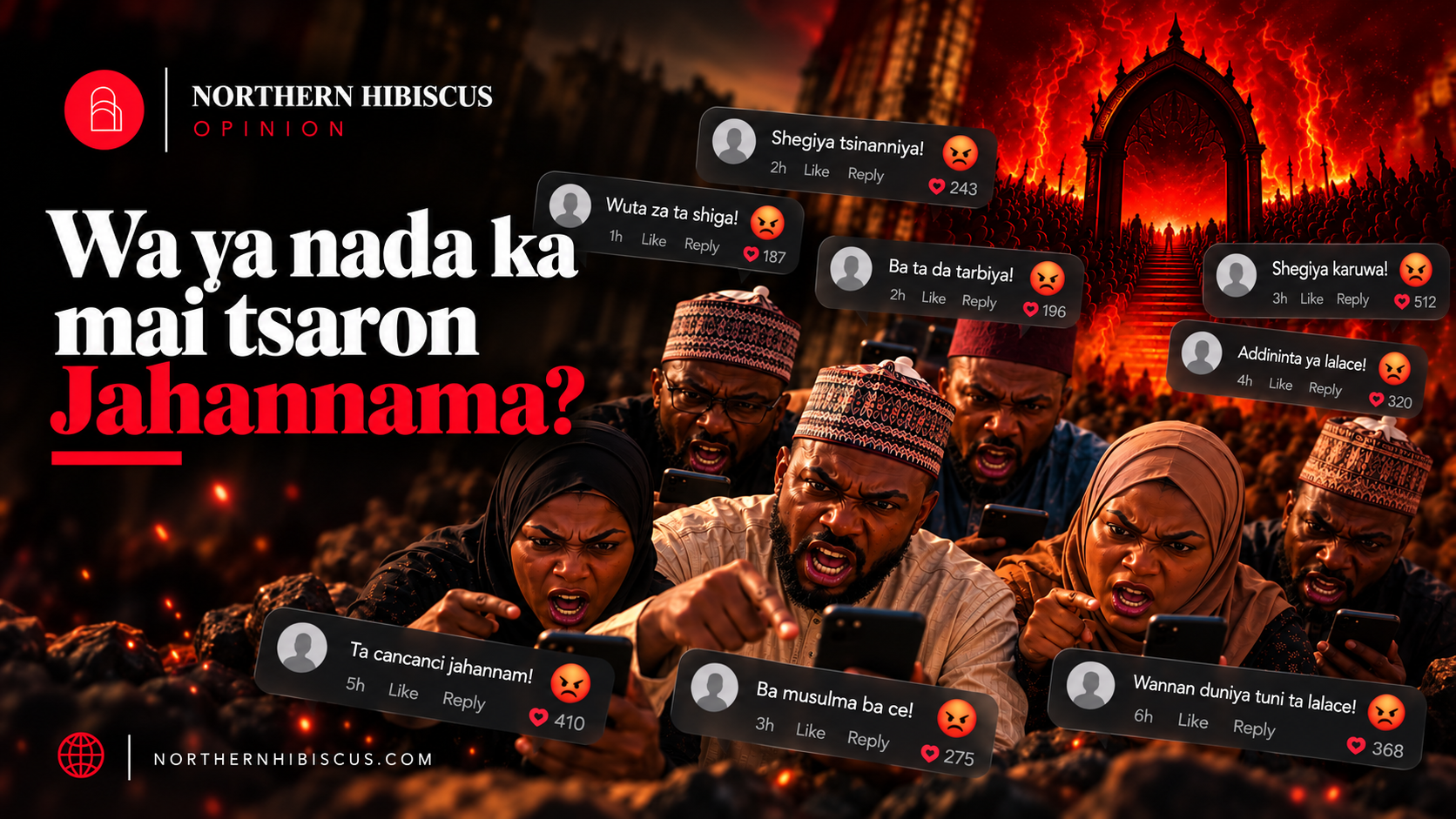
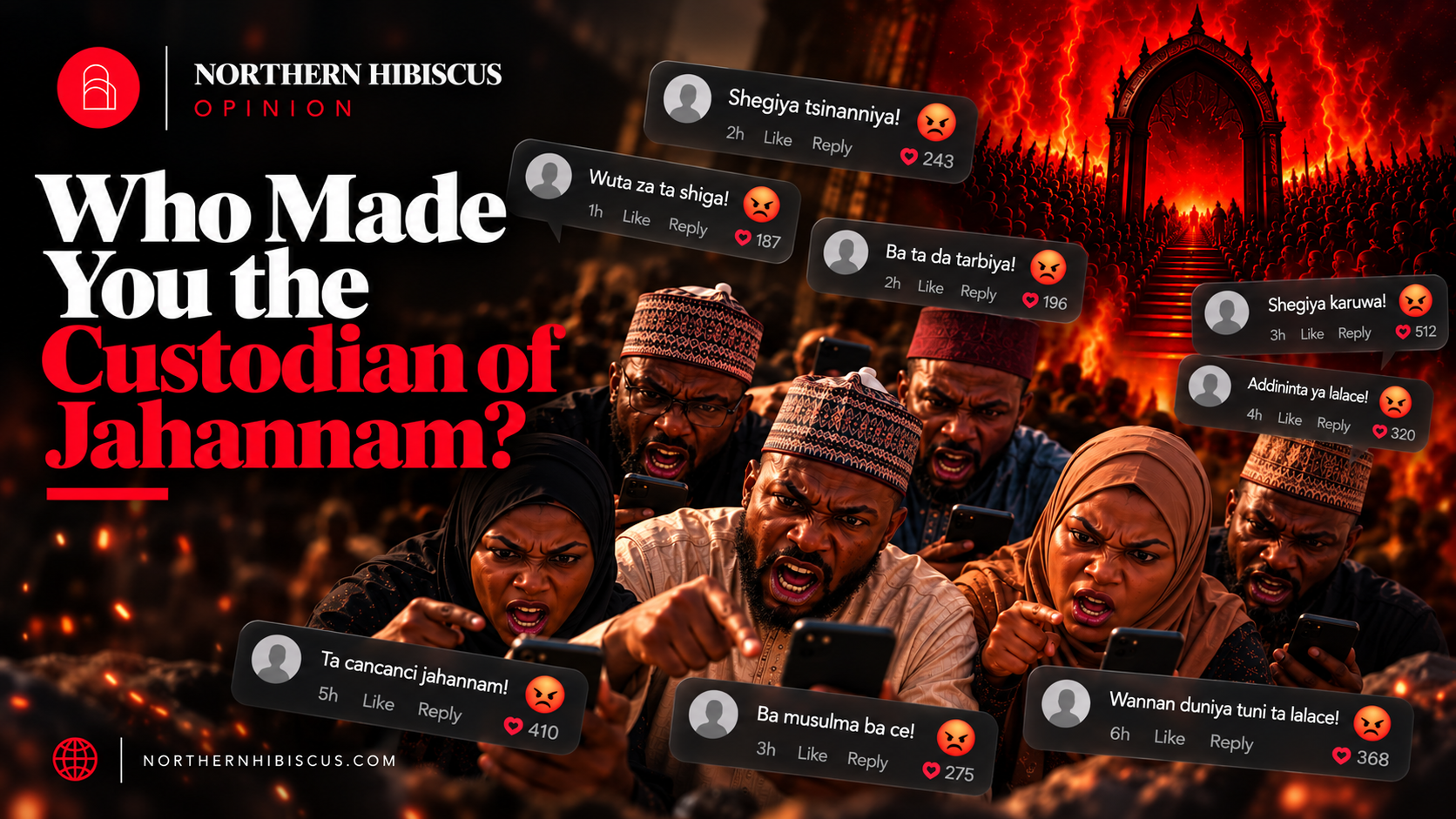
How does it feel to look at someone on social media and confidently sentence them to hellfire?
Well, if you want to know, ask the experts. The self-appointed custodians of Jahannam in Northern Nigerian comment sections.
I have been watching this trend on instagram and TikTok. Someone posts a two-minute video, and before you can even finish watching it, people have already judged the person’s character, questioned their faith, condemned their choices, and decided where they will spend eternity.
Just two minutes of somebody’s life, and suddenly, you know everything about their relationship with Allah.
Kai!
Ba ka san matsayin mutum a wurin Allah ba.
You have never met this person. You do not know their private struggles, their prayers, their good deeds, their regrets, or the battles they fight when nobody is watching. You have only seen a tiny fraction of their life on a screen.
Yet somehow, you have appointed yourself the custodian of heaven and hell. You have denied someone entry into Jannah and issued them a ticket straight to Jahannam.
Abin yana bani mamaki!
Honestly, sometimes I go through these comment sections and wonder: Kash, jahilci ya yi yawa!
But then I ask myself, what exactly is happening here?
Shin rashin sanin addini ne? Ko rashin iya mu’amala ne? Ko rashin wayewa ne? Ko kuwa mun kai matsayin da ganin mutum ya yi abin da bai yi mana daidai ba yake ba mu damar wulaƙanta shi?
Because I genuinely want to understand.
If you believe someone has done something wrong, is there no way to correct them without insulting them? Is there no way to offer advice without humiliating them in front of thousands of people?
In da gaske gyara za ka yi wa mutum, akwai yadda za ka yi hakan cikin hikima da mutunci.
You can offer sincere advice. You can make du’a for them if you genuinely believe they have done wrong. You can send them a respectful private message, where appropriate. You can explain your religious position without turning the person into a public punching bag.
But no.
You have to drag them. Insult them. Question their upbringing. Attack their family. Declare that they have no shame, no religion, and no fear of Allah.
And, of course, finish everything with the final verdict:
“Wuta za ta shiga!”
Congratulations! Another human being has been sentenced by the comment-section court.
But I have one question for you.
WHO EXACTLY ARE YOU TO CAST PEOPLE INTO JAHANNAM?
Is Jannah your father’s house? Is Jahannam your personal property? Did Allah appoint you to sit at the gates of heaven and hell, deciding who gets in and who must be turned away?
Waye kai? Kuma waye mahaifinka?
Before You Send Someone to Jahannam, Let Us Talk About You
Before you start distributing tickets to Jahannam, can we talk about you for a moment?
Kana yin sallah a kan lokaci?
Kana azumi yadda ya kamata?
Ka taɓa bayar da zakka idan ta wajaba a kanka?
Ka san haƙƙin maƙwabcinka?
Kana yi wa iyayenka ladabi?
Kana cika alkawari?
Kana faɗin gaskiya ko da gaskiyar za ta sa ka rasa wani amfani?
Kana kiyaye amanar da aka ba ka?
Kana kyautata wa mutanen da ba su da abin da za su ba ka?
Kana yi wa ’yan’uwanka Musulmi kyakkyawan zato?
Kana guje wa gulma, ƙarya, hassada da cin mutuncin mutane?
And before you say, “That is none of your business,” you are absolutely right. I am not claiming to know your private life or your relationship with Allah.
That is precisely my point.
If I cannot look at your social media account and confidently determine your standing before Allah, what gives you the confidence to do the same to another person?
Why is it that your own shortcomings deserve privacy, understanding, and the possibility of forgiveness, but another person’s mistake deserves a public trial?
Why do we extend understanding to people we love, people we admire, and people who agree with us, but suddenly become the appointed judges of heaven and hell when the person is a stranger?
It really baffles me.
A Woman’s Dress Is an Emergency, but Where Is the Anger Towards Kidnappers?
And what makes it worse is the contrast.
In Northern Nigeria, kidnappers are abducting people, terrorising communities, and leaving families living in fear. People are being taken from their homes, their farms, their roads, and their communities. Families are desperately hoping their loved ones will return alive.
But where is that same level of anger directed at the kidnappers?
Where is the outrage? Where is the determination to condemn the people responsible for these crimes? Where is the same energy in demanding accountability from those who abduct innocent people and terrorise entire communities?
Yet look at how quickly a different kind of outrage can erupt online.
Let a woman appear in a video wearing a short-sleeved dress, and suddenly:
“Macce ta saka short sleeve, ai wuta za ta shiga!”
The comments start flying. The insults multiply. People begin analysing her entire life, her morality, her upbringing, and her relationship with Allah.
I have often wondered why some comment sections appear more eager to condemn a woman’s clothing than to express the same intensity of anger towards the people kidnapping and terrorising our communities.
Of course, people do speak against insecurity and injustice. I know that. But the contrast in the way we sometimes react online is disturbing.
Why are we so eager to police what a woman wears, yet sometimes so reluctant to confront the injustices that destroy lives?
I am not saying that modesty should not matter. I am not saying that religious obligations should be ignored. I am asking why religious advice sometimes becomes an excuse for cruelty, while the people responsible for real suffering do not always attract the same intensity of public condemnation.
Are We Correcting People or Enjoying the Opportunity to Humiliate Them?
If Islam teaches us peace, mercy, humility, and accountability, why are we terrorising one another in the name of religion?
Why are we making people afraid to ask questions, admit mistakes, or seek guidance because they know they will be mocked, insulted, and publicly condemned?
If a young woman’s experience of religious people online is mainly insults, threats, and declarations that she is destined for hell, what exactly are we teaching her about the mercy of Allah?
If a young person makes a mistake and the first thing we offer is humiliation, are we guiding them towards improvement, or simply making ourselves feel superior?
We need to relearn how we practise our religion.
We need to understand that there is a difference between correcting someone and destroying their dignity. There is a difference between explaining what you believe is right and pretending you know the final judgement Allah will pass on another person.
There is a difference between advising someone and behaving as though you own their future.
Allah bai ba ka ikon yanke hukuncin makomar kowa a lahira ba.
You can tell someone that you disagree with their actions. You can explain why you believe those actions are wrong. You can encourage them to do better.
But you cannot see two minutes of their life and confidently claim to know the full state of their faith, the contents of their heart, or their final destination.
Allah knows what we do not know.
And if we truly believe that Allah is Al-Ghafur, Ar-Rahim — the Most Forgiving, the Most Merciful — why do we sometimes speak as though forgiveness is impossible for the people we dislike?
Do we believe in repentance only when it concerns us?
Do we believe in mercy only when we are the ones who need it?
Do we remember that we are all human beings who make mistakes, or have we convinced ourselves that the person we are criticising is somehow beyond Allah’s mercy?
I am not asking anyone to abandon their faith. I am asking us to take it seriously enough to examine ourselves.
Before you condemn someone, learn.
Before you preach, reflect.
Before you humiliate someone, consider whether your own conduct reflects the values you claim to defend.
And when you see someone doing something you believe is wrong, remember that you can offer correction without cruelty.
Who Made You the Custodian of Jahannam?
We can discuss religious obligations and still condemn the people who kidnap and terrorise our brothers and sisters.
We can disagree with someone’s choices without pretending to know their standing before Allah.
These things are not mutually exclusive.
So the next time you see someone on social media and feel the urge to announce that they are going to hell, pause for a moment.
Ask yourself: Am I offering sincere advice, or am I enjoying the opportunity to humiliate someone?
Am I speaking from knowledge and humility, or from anger and a desire to feel superior?
Am I helping this person improve, or am I simply performing righteousness for an audience?
And when you see reports of kidnappings and the suffering of innocent families, ask yourself whether you are directing your anger towards those responsible for the harm.
WHO MADE YOU THE CUSTODIAN OF JAHANNAM?
Allah called Himself Al-Ghafur, Ar-Rahim.
The Most Forgiving. The Most Merciful.
May Allah teach us to advise one another with wisdom, correct one another with kindness, condemn injustice with courage, recognise our own shortcomings, and never become so confident in judging others that we forget our own need for His mercy.
Allah Ya shiryar da mu. Ya gyara zukatanmu. Ya kare al’ummominmu daga masu garkuwa da mutane, Ya ba iyalan da abin ya shafa haƙuri da kariya, Ya kuma sa mu zama masu tausayi, hikima da adalci. Amin.
Northern Hibiscus Opinion | The news that hits home.