
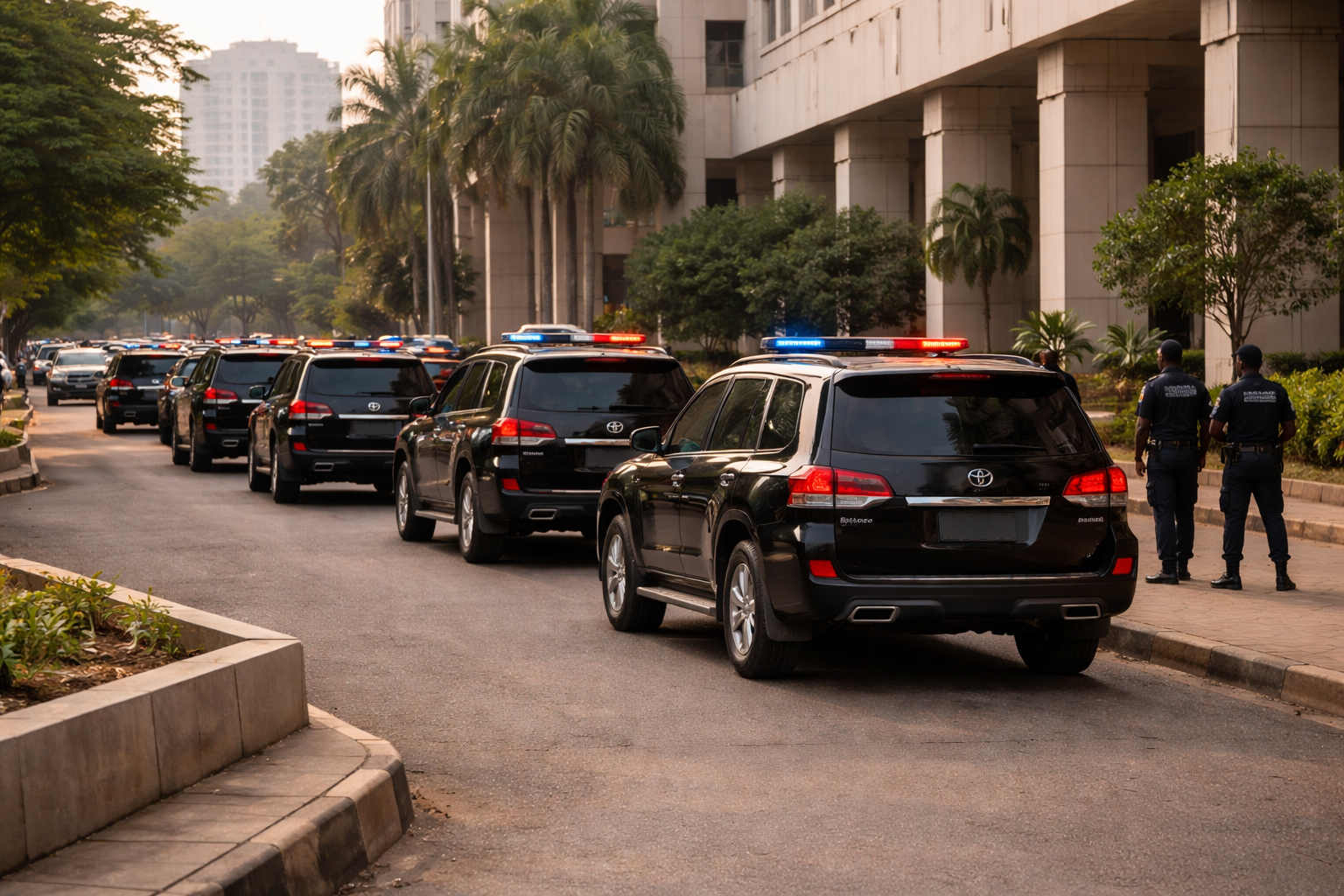
It usually begins with sirens.
A pilot car moves ahead. Another follows. Then the main vehicle. Then security. Then protocol. Five cars. Seven cars. Sometimes more. Traffic slows. People step aside. The convoy passes and the road returns to normal.
Nothing about this feels unusual in Nigeria. What is unusual is how rarely anyone asks what it costs.
Convoys are not a scandal. They are not illegal. They are simply routine. And that routine, repeated thousands of times across the country, is quietly expensive.
Who Actually Moves With Convoys
Convoy culture is not limited to the presidency or state governors. It stretches across nearly every layer of power.
Governors and deputy governors move with convoys. So do first ladies. Federal ministers and ministers of state. Heads of federal and state agencies. Senators. Members of the House of Representatives. Speakers of state assemblies. State legislators. Local government chairmen. Senior traditional rulers. Former office holders with retained security.
Each role can justify security. Each justification adds vehicles. Each vehicle burns fuel.
The result is not excess in one place, but multiplication everywhere.
The Math People Avoid
To understand the scale, the assumptions must reflect reality.
A typical convoy today often consists of seven vehicles. A pilot car, a lead vehicle, the principal car, a follow vehicle, backup, security, and protocol.
Each vehicle, moving through traffic and idling at events, consumes about 25 litres of fuel per day. At an average pump price of ₦900 per litre, that comes to ₦157,500 per convoy per day.
Convoys do not observe weekends or public holidays. A realistic operating year is about 330 days.
That means one convoy costs roughly ₦52 million per year in fuel alone.
That is one.
Now Count Power Honestly
At the state executive level, a conservative estimate includes a governor, deputy governor, first lady, speaker, secretary to the state government, chief of staff, and at least ten commissioners and agency heads. That is 16 convoys per state.
Across 36 states, this comes to about ₦30 billion annually.
State legislatures add another layer. Speakers, principal officers, and highly mobile lawmakers operate their own convoys. A modest estimate of 15 convoys per state adds nearly ₦29 billion nationwide.
At the National Assembly, Nigeria has 109 senators and 360 members of the House of Representatives. Not all run full convoys daily, but many do. Assuming 200 active convoys, the annual fuel cost is over ₦10 billion.
The federal executive and agencies, including ministers, heads of MDAs, and senior advisers, account for another ₦6 billion.
Local government chairmen, numbering 774 nationwide, further expand the count. Even assuming only 400 operate regular convoys, the cost exceeds ₦21 billion.
Add traditional institutions, special envoys, and former officials with retained security, and the number rises again.
Taken together, conservative estimates suggest Nigeria may be spending almost ₦130 billion every year on convoy fuel alone.
This figure does not include vehicle purchase, maintenance, tyres, drivers’ salaries, or the cost of engines idling for hours at meetings, summits, weddings, funerals, and ceremonies.
This is fuel only.
Security or Status
Nigeria is not a safe country. Security matters.
But convoy size often reflects rank more than threat. The higher the office, the longer the motorcade. Not because intelligence demands it, but because power is expected to look like power.
Convoys perform authority. They reassure those inside them. They signal importance to those outside.
They also quietly burn public money.
The Way Out Is Smaller Than It Sounds
Fixing convoy culture does not require new laws or heroic reforms.
It requires subtraction.
Most convoys today operate with six to eight vehicles. Cutting that number by just three cars per convoy would not remove security. It would remove excess.
Three fewer vehicles, each consuming 25 litres of fuel per day at ₦900 per litre, saves ₦67,500 per convoy per day.
Over a year, that is about ₦22 million saved per convoy.
Across Nigeria’s existing convoy network, trimming just three vehicles could save roughly ₦50 billion every year.
Not through sacrifice. Through restraint.
What ₦50 Billion Could Do Instead
₦50 billion redirected annually would not solve all of Nigeria’s problems. But it would matter.
It could strengthen primary healthcare centres and maternal care.
It could fund youth skills, apprenticeship, and job creation programmes.
It could support vocational hubs and small business grants across states.
It could improve teaching hospitals and essential drug supply.
It could upgrade classrooms and learning infrastructure.
These are not abstract ideas. They are budget lines that already exist and are often described as underfunded.
Why This Is Politically Possible
Reducing convoys does not weaken authority. It reframes it.
In a country where trust in government is thin, visible restraint sends a signal. It says leadership does not need excess to function. It says power can move lightly and still be respected.
Other countries do this quietly. Nigeria could too.
The change does not begin with budgets. It begins with decisions.
What Convoys Reveal About Governance
Convoys are not Nigeria’s biggest financial problem. They are its clearest mirror.
They show how public money leaks not only through corruption, but through habit. Through repetition. Through systems designed for visibility instead of efficiency.
Three fewer cars. Billions saved. A different signal sent.