
Nigeria’s political map has been changing for months, but the full shape of it is only now becoming clear.
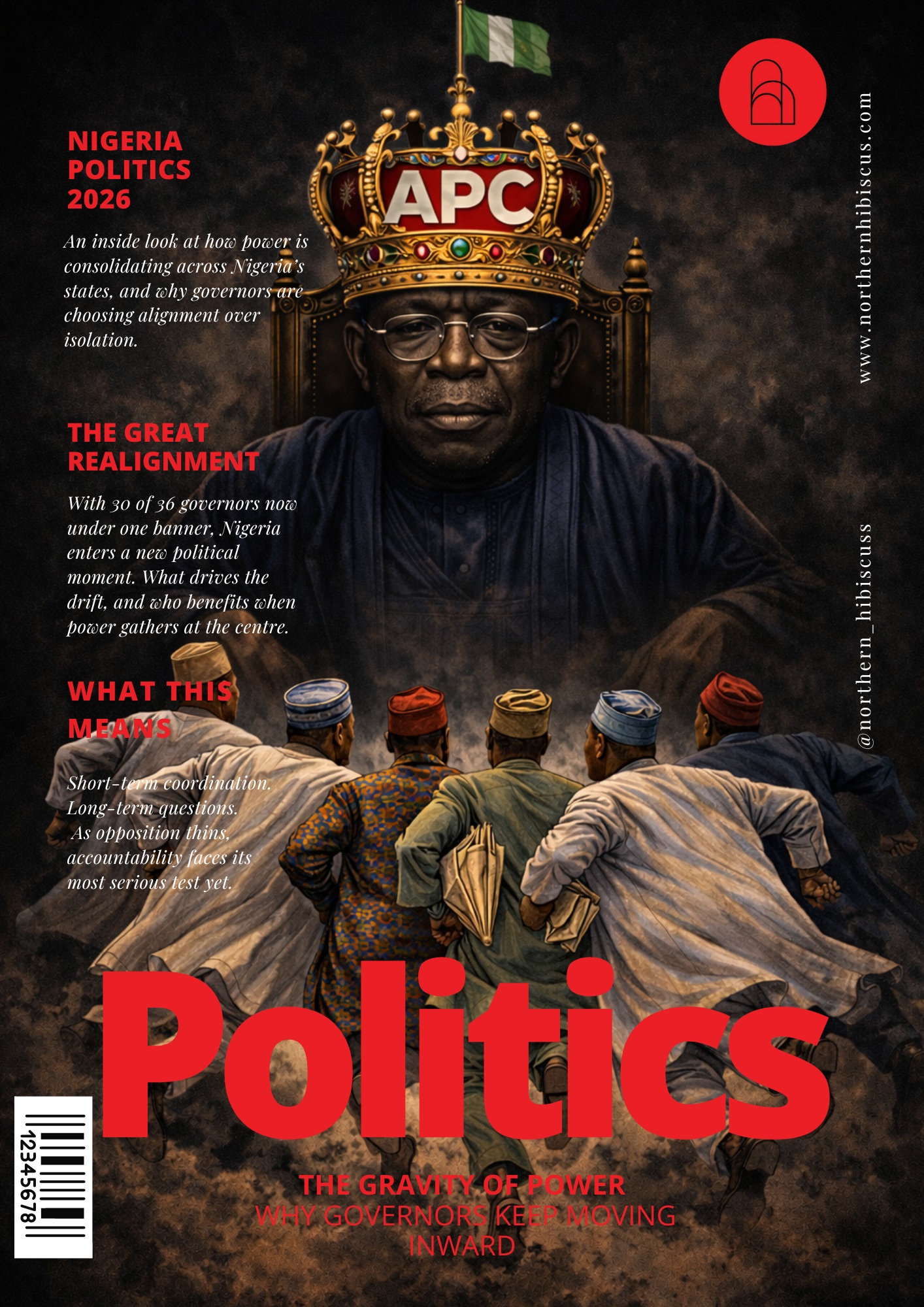
With the 2027 general elections still two years away, the ruling All Progressives Congress has consolidated control over about 30 of the country’s 36 state governments, following a series of defections by sitting governors. The movement has been steady rather than dramatic, unfolding through party switches that span regions, personalities, and political histories.
Governors elected under the banners of the People’s Democratic Party and the New Nigeria Peoples Party have been among those crossing over. States such as Enugu, Bayelsa, Plateau, Delta, Rivers, and Kano are now governed by leaders aligned with the ruling party, shrinking the opposition’s hold to a small cluster of states.
The arithmetic alone is striking. The politics behind it are more familiar.
For governors, alignment with the centre has long carried practical advantages. Security coordination, federal infrastructure spending, and regulatory approvals all flow through Abuja. Party affiliation does not determine access in law, but in practice it often shapes how quickly doors open and how easily conversations move forward.
As the next election cycle approaches, those calculations have sharpened.
Some defections were announced with rallies and public ceremonies, designed to signal confidence and finality. Others came quietly, through letters and brief statements, followed by formal receptions that lasted less than a day. The choreography varied. The logic did not.
Political timing has played its part. Governors nearing the end of their terms, or managing complex succession plans, have shown little appetite for uncertainty. Large national parties offer organisational depth, campaign resources, and predictability. Fragmented opposition parties offer fewer guarantees.
The condition of the opposition has also mattered. Internal disputes within the PDP, once the country’s dominant political vehicle, have complicated efforts to hold governors together. For state executives under pressure to deliver security improvements and economic results, party instability has become another risk to manage.
The realignment has cut across geography. Northern and southern states have moved in tandem. Oil-producing states and agrarian ones have responded to the same incentives. What began as individual decisions has coalesced into a national pattern.
For the governing party, the consolidation brings obvious benefits. Coordination between federal and state governments becomes easier when political differences are internal rather than adversarial. Policy priorities face fewer roadblocks. Disputes are handled within party structures rather than across the aisle.
For the broader system, the implications are more ambiguous.
Nigeria’s democracy has never been short on parties, but it has often struggled to sustain strong opposition at moments of political concentration. When most governors operate under a single banner, debate does not disappear, but it tends to migrate inward, away from public contestation.
Supporters of the current alignment argue that it offers stability at a time of economic strain and security pressure. Critics worry that competition is thinning too early in the electoral cycle, leaving voters with fewer meaningful choices long before campaigns begin.
Neither view is new. Nigeria has seen periods of political consolidation before, followed by fragmentation when alliances shift and fortunes change.
What stands out this time is scale. Thirty governors aligned with one party reshapes not just electoral math, but the incentives that govern political behaviour across the federation.
With two years still to go before Nigerians return to the polls, the question is less whether power has gathered than how it will be used, and whether space will reopen for contest as the election draws closer.